



 Petronet LNG Limited is one of the fastest growing world-class Public Limited Company in the Indian energy sector. It has set up the country's first LNG receiving and regasification terminal at Dahej, Gujarat with present nominal capacity of 17.5 MMTPA and another terminal at Kochi, Kerala having a nominal capacity of 5 MMTPA. The company is also exploring suitable opportunities within and outside India to expand its business presence.
 The Company had set up South East Asia's first LNG Receiving and Regasification Terminal with an original nameplate capacity of 5 MMTPA at Dahej, Gujarat. The infrastructure was developed in the shortest possible time and at a benchmark cost. The capacity of the terminal has been expanded in phases which is currently 17.5 MMTPA and the same is under expansion to 22.5 MMTPA in two phases. The terminal has 6 LNG storage tanks and other vaporization facilities. The terminal is meeting around 40% of the total gas demand of the country
LNG
What is Liquefied Natural Gas?
The very concept of Liquefied Natural Gas (LNG) is a response to the inefficiency of natural gas pipelines and the technical and economic problems of running pipelines over long distances.
Liquefied Natural Gas consists mainly of Methane (typically methane (85-99%)) and small amounts of other fractions of C2+ components like ethane, propane and butane. It is colorless, odorless, non-toxic, transparent and in liquid form ~45% density of water. Considered as one of the most environment friendly fossil fuel.
Natural Gas (NG) is converted into Liquid form i.e. Liquefied Natural Gas (LNG) by cooling it to -260°F (-162°C). Cooling process reduces the volume of gas by 600 times i.e. LNG becomes 1/600 volume of natural gas, thereby making it convenient to transport by cryogenic vessels.
As LNG is highly volatile, specialist operators are involved in its transportation.
A TYPICAL LNG CHAIN
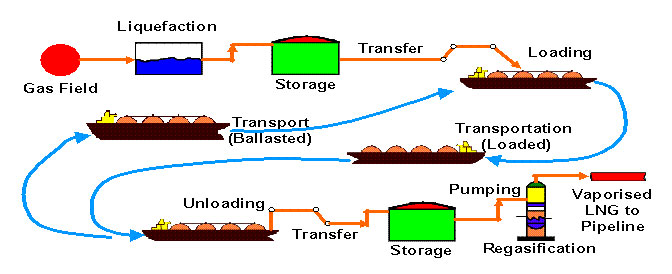
Primary LNG Project / Chain Components are:
- Upstream development of long-term natural gas supply for feed gas to an LNG plant
- Downstream development of liquefaction , storage and loading facilities
- Marine transportation
- Downstream development of receiving terminals for regasification and pipeline transportation to market
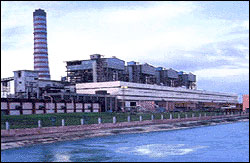 Natural Gas is not only efficient, clean, eco-friendly and flexible in control, it meets many of the fuel requirements of modern industrial society. LNG's main applications are:
Electricity generation : Fuel for base load and combined cycle/ co-generation power plants.
Public and commercial : This clean fuel, which is cheaper than LPG, can be used as piped gas for households. In the West, most household consumption is accounted for by piped gas, whose use is increasing rapidly.
 Industrial : Industrial : Under boiler fuel for steam raising and heating applications.
Alternative motor fuel to diesel : The use of natural gas as fuel for automobiles is increasing rapidly as it is 30 to 40% more efficient and much cleaner than traditional fossil fuels. With only one carbon and four hydrogen atoms per molecule, it is the most eco-friendly option and is gaining increasing relevance in the age of Global Warming and Climate Change.
Petrochemicals : Several vital chemical products, e.g. methanol, can be derived from natural gas.